
Michael Koresky put it best in his 2017 article for Criterion-director Rainer Warner Fassbinder’s vision of life in “Fox and His Friends” (1975) is such that, “Sex and money are purely transactional, and while life is characterized by hopeless circularity, death offers no transcendence.” The underlying world view seems to be nihilism.
You must use or be used. When we first meet Fox, he is young, naive, sex-driven, and desperately searching for fulfillment. He and his friends run a carnival scam. He is lower class but wants to elevate himself. His cheap but bedazzled denim jacket with his nickname on it represents his tragic dream to be more. He seems delusional at first when he claims he will win the lottery but by some mystery of fate it is soon fulfilled.
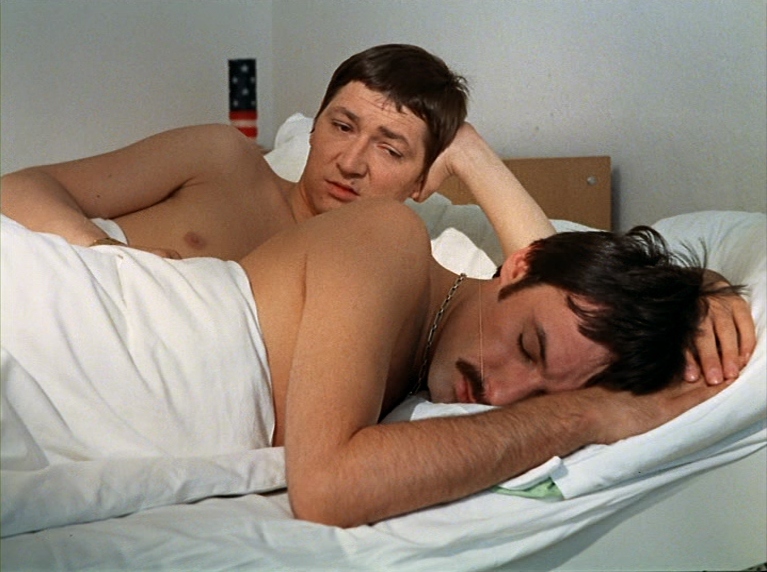
When Fox falls in with a new, posher crowd after his lottery win, love becomes linked to social status. Eugen only leaves his like-minded lover Philip when he learns of Fox’s new wealth, and is mortified and disgusted by his lower-class tendencies. Fox is constantly sacrificing to sustain this new love. Things go sour when Fox realizes what the audience realize all along. His new friends and new lover don’t care about him at all. They are using him for his money to elevate themselves. When they are done with him, they toss him aside.
To me, “Fox and His Friends” is not a movie about the struggle of being a gay man. Gayness is normal among Fox and his friends. Fox does not suffer because of any persecution related to his sexuality, but instead his social class. I was interested to read that the film drew criticisms and backlash for its representation of gay men, as Fox’s circle of friends is shallow, selfish, and materialistic. Andrew Britton, a critic, wrote in “Gay Left” in 1976 that its “version of homosexuality degrades us all and should roundly be denounced.”
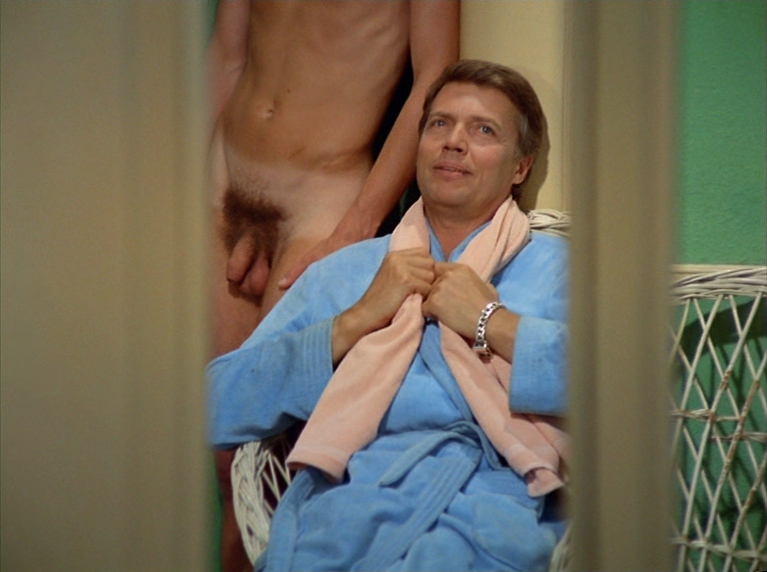
Fassbinder responded to the criticisms and claimed that to him, the film was not about gayness. At the Cannes Film Festival in 1975, he said, “Here, homosexuality is shown as completely normal, and the problem is something quite different. It’s a love story, where one person exploits the love of the other person, and that’s really the story I always tell.”
Fassbinder’s vision was how I read the film on first viewing. Fox is a tragic character. He goes from nothing, to something, to nothing again. He desired money and love and got the briefest glimpse of it before it was all taken away. He dies alone in a subway in his bedazzled jacket, the final marker of his identity, while unbothered young boys dig through his pockets to take whatever remains.

 Film, Gender, Sexuality