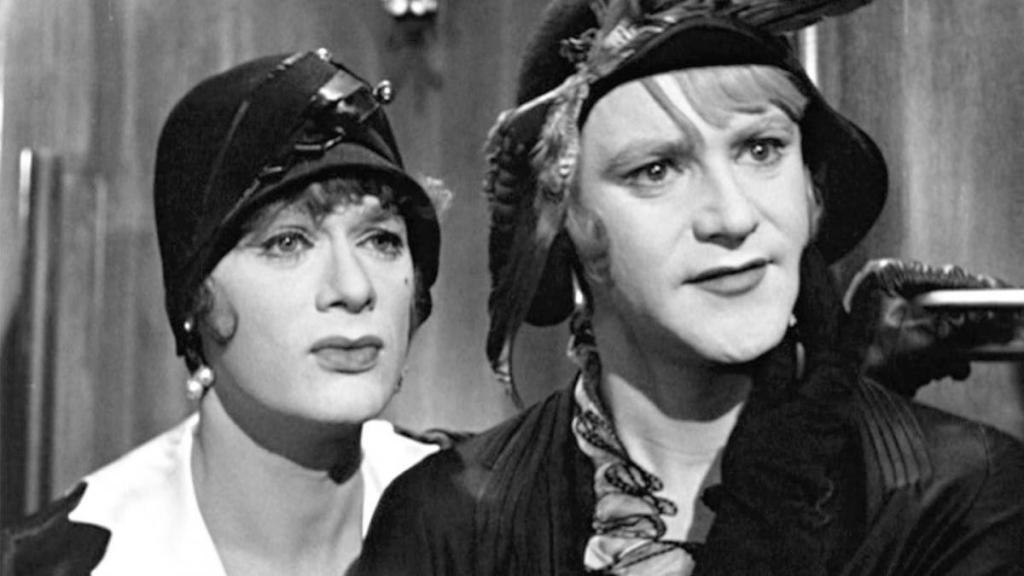
“The Celluloid Closet” (1995) directed by Rob Epstein, and Jeffrey Friedman massively opened my eyes as a heterosexual in the industry. Not only did the film inform me of the history of queer representation that had sometimes flown over my head, but it also provided the full spectrum of gay representation.
What struck me near the opening of the film was the idea that films “taught straight people how to think about gay people, and taught gay people how to think about themselves.” And to that end, “we learn from the movies what it means to be a man or a woman.” The screen acts as a mirror, and people are desperate to see themselves in that mirror.
The “sissy,” the first gay character that started cropping up in movies, was always the butt of the joke. “When men dress like a woman, everyone laughs, but when a woman dresses like a man nobody laughs. They just think they look wonderful.” Then from the sissy, the next level in representation became gay characters as villains. From the obsessive, leering gay woman in “Rebecca,” to the murderous lovers in “Rope.”
In 60’s America, gay characters were unhappy, suicidal or murdered, and lonely. They had to suffer or pay. Maxim de Winter (“Rebecca”) goes down in a blaze, Plato (“Rebel Without a Cause”) is gunned down by police, and Martha (“The Children’s Hour” hangs herself in her room when she realizes she loves another woman. “The Boys in the Band” (1970) is one of the earliest images of gay camaraderie, and all of the gay men survive.
As time went on, the downside to gay visibility became the threat of retaliation. In “Vanishing Point,” the audience laughed as queer hitchhikers were foiled in their robbery attempt and shoved out of the car. When a trans villain is foiled in their murder plot and is gunned down, the audience applauds. “The audience was applauding the death of the villain and the death of a homosexual.” In “Cruising” (1980), gay characters transitioned from victims to victimizers. But in “Making Love,” (1982) there was imagery of a tender and loving gay relationship between men.
I would love to see a continuation of this film that tackles gay representation in the present, as there is still a long way to go for gay characters.






 Film, Gender, Sexuality